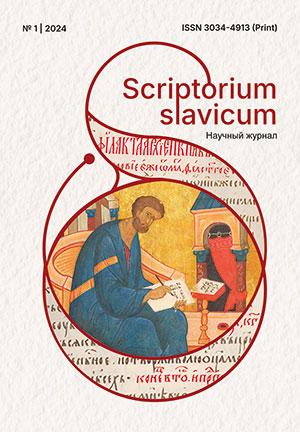
Scientific journal Scriptorium slavicum is published since 2024.
The journal has a print run of 100 per issue, with 4 issues published per year.
Distributed in the Russian Federation and other countries.
The digital version of the journal with multimedia addenda is available at scrisla.elpub.ru.
Founder: Federal State Budgetary Institution of Science State Public Scientific and Technological Library of the Siberian Branch of the Russian Academy of Sciences (SPSTL SB RAS).
The journal Scriptorium slavicum publishes material on the issues of literary and linguistic source studies in the aspects of archaeography, textual criticism, poetics of Russian literature of the Middle Ages and Early Modern period, as well as the search for its genetic and textual links to the literature of the 20th–21st centuries.
The journal publishes articles on topical issues of Slavo-Russian medieval studies and the history of Russian literature, representing the current state of world research on literary monuments and the work of authors and scribes of the Russian Middle Ages. Preference is given to works that offer innovative and original ideas, evidence of scientific discoveries in the development of issues that have a long or, conversely, a recent tradition of study, as well as articles based on the complexity of research approaches and methods. The journal also accepts publications with scientific editions of written sources, especially newly discovered and previously unknown to scientists.
Current issue
EDITORIAL ARTICLE
ISSUES OF TEXTUAL CRITICISM AND POETICS OF OLD RUSSIAN LITERATURE
The aim of the article is to analyze the version of the Great Canon of Repentance by St. Andrew bishop of Crete, found so far in the unique manuscript – the East Slavonic Lenten Triodion of the 14th century F.304/I, no. 25 from the Manuscript Collection of the Trinity Lavra of St. Sergius stored in the Russian State Library. The use of the Greek origin for the compilation of this particular version of the text is proved, the Slavonic editions which served as a basis for the corrected version are revealed, the peculiarities of the version’s language and poetics, as well as the changes made by the anonymous editor are analyzed. The editor’s insertions in the Slavonic text – additional troparia not found in the authentic text of the Canon, probably translated from the Greek manuscript – are identified and described. Suggestions are made as to the place of composition of the version and the reasons for its low circulation.
Among the texts found in the Russian literature, the author of which is named as “Cyril” or “Cyril of Turov”, a significant part of the works does not belong to the Old Russian writer of the 12th century, but is attributed to him. Some manuscripts of the 16th–17th centuries (Canons and Augmented Psalters) include two texts not without some grounds attributed to bishop Cyril. They were created by scribes who knew his work well, and were published by M.I. Sukhomlinov in 1858 according to a manuscript copy of the 17th century. The title of the first oeuvre varies: “Cyril bishop of Turov’s Kindest Verses to Confession and Demise / Blame for Those Who Want to Mourn Unceasingly the Unbecoming Deeds”. It uses some words and expressions from the writer’s weekly prayers and the structure of praise to the holy fathers from “The Sermon of Remembrance to the Fathers of the Council of Nicaea” in petitions addressed to the holy fathers, hierarchs, apostles, and martyrs. The text varies greatly in the copies, which is due to its history in the Russian writing. The second oeuvre is called “The Prayer of St. Cyril uttered on all days”. Its author worked differently: he included in the text rather large fragments from Cyril’s prayer after Saturday Matins, making minor changes in them. This text, as far as one can judge from the studied copies, is quite stable.
In the personal collection of Lidiya P. Zhukovskaya, famous researcher of old Slavic literature, kept in the Department of Manuscripts of the Russian State Library, among other unpublished materials are her letters to famous scientists of the second half of the 20th century. The article reveals previously unknown facts about the biography of Lidiya P. Zhukovskaya and her family members. Her letters with various correspondents contain valuable information about the fruitful scientific communication between domestic and foreign scientists, about the current problems of studying the textual criticism and language of Slavic written monuments.
LINGUISTIC SOURCE STUDIES
The article is devoted to the actual topic of lexical variation in early translations from Greek into Slavic. The research material is based on the texts of the Miscellany of 1073 and "13 Orations of Gregory Nazianzen" (based on a manuscript of the 11th century, published by A.S. Budilovich). The article provides, analyzes and classifies examples of lexical synonymy, the emergence of which is due not to the processes of existing of the texts, but to the intentions of translators. In addition, cases of synonymy of syntactic constructions are considered, as well as different ways of including Greek loan words in synonymous series. It is concluded that the phenomenon of synonymous variation was not only a part of the translation technique of the Slavic first teachers Cyril and Methodius, but also further developed in the works of their followers, including quite distant ones.
The article deals with two homilies on the Synaxis of the Theotokos Virgin included in the Menaion Panegyricon BAN, f. 39, 21.4.4. (Nov. 928). The aim of the article is to describe the detected phonetic and orthographic differences in the repeating parts of these homilies and to determine the reasons of their occurrence, using the linguotextual method in functional and structural aspects.
The examined homilies differ in volume and content. The larger sermon numbered as 30 in the manuscript is designated as a work of Epiphanius of Cyprus. This Homily is found in 19 Menaion Panegyrica of the 15th–16th centuries. Homily under number 31 consists of two parts: the beginning of the Synaxis of the Theotokos Virgin by Epiphanius of Cyprus, the continuation – part of the Homily on the Nativity of Our Lord by Gregorius of Nazianzus. The linguotextual method was used to explore the discrepancies in the general part of the homilies. This study suggested that there are two editions of the Synaxis of the Theotokos Virgin by Epiphanius of Cyprus. This conclusion allows us to continue studying this Homilies as a subject of linguotextual studies.
Medieval translators’ paratexts (prefaces- prologues and postfaces-epilogues in particular) provide abundant study research materials for philologists and linguists. They contain both true biographical evidence and an image of an “ideal” translator or scholar constructed from several topoi (loci communes). The article deals with several motifs (topoi) extracted from translators’ paratexts and related to translatio studii in its original and corporeal meaning, namely physical transfer of artefacts (books, scrolls) bearing the knowledge sought by the scholars and the travel of the latter in search of the artefacts. As medieval culture considered the antiquity of a book to be a significant factor of its prestige and authenticity, an “accidental discovery” of an ancient and unknown book topos (motif) was quite common in translators’ paratexts. Another topos, which emphasized the dedication and diligence of a scholar, was a motif of a long and tiresome search, which implied overcoming various obstacles and facing dangers by the scholar (translator), who was trying to find a book he had heard about and was eager to obtain and make accessible to others. Translators’ prologues and epilogues, as well as marginal glosses in the book itself, also give information about other ways a manuscript (an expensive and often richly adorned artefact) could find itself in a new culture, such as being a war trophy or a diplomatic gift. Translators’ paratexts also provide us with evidence of scholars’ attitude to and handling of their books as artefacts and their concern about the preservation and propagation of their work.
Many East or Southeast Asian toponymic doublets (including nesonymic units), as well as their graphic variants, are present in the Russian text vocabulary of the 18th-20th. due to different traditions of incorporating written exoticisms, though they do not always correspond to real geographical objects. This research focuses on Russian texts that include Taiwanese nesonyms. The primary objective is to identify the complete range of these units and, if feasible, to clarify their association with real or imaginary islands to ensure adequate reader reception or interpretation.
To find the reasons for the use of doublets or variants in texts is also important. In the Russian vocabulary, the system of Taiwanese (by origin) historical and modern nesonyms includes hundreds of units and reacts to constantly updated geographical data or cultural and geopolitical events. On the other hand, this system preserves evidence of the ways in which Russians assimilated exoticisms in their texts. Moreover, toponymic variants and doublets in general, and nesonyms in particular, are not associated solely with the instability of the graphic, phonetic, lexical, or morphological norms. A pedantry in writing chains of doublets or variants can be explained by the conscientiousness of the translator, lexicographer, cataloger, navigator, and others, who desire to provide their readers with comprehensive information about the names of little- known topographic objects. The coexistence of nesonymic doublets and variants (that at first glance seems to hinder the establishment of literary or conventional norms for the use of exoticisms) signals the level of education of the author or translator and their knowledge of foreign languages. In a stylistic sense, the use of lexical doublets and graphic variants turns into a sign of educational texts.